 EN












PFERD TOOLS on grinding process coordination: how can abrasive trials be compared?
Published
How to align trial conditions, record quality and abrasive consumption, and calculate abrasive cost per accepted part, with a blank Excel comparison form.
Comparable abrasive trials start with an agreed objective, processing conditions and acceptance criteria. Quality, abrasive consumption and machining time must then be recorded within the same scope. Faster processing, a lower unit price or the output of one trial alone does not establish which option suits the customer. For abrasive manufacturers, a record that traces samples and explains differences provides a basis for describing product applicability.
News background: from individual tools to process coordination
In its robotics press release dated September 15, 2026, PFERD TOOLS said automation projects should first define machining quality, tolerances, cycle time and existing process variation, before specifying the tool, drive system and robot integration requirements. The company noted that repeating the same robot motion does not by itself ensure consistent results. Tool wear, material differences and changing machining forces must also be considered in process design. Source: PFERD TOOLS official release
In another article released on the same date, the company extended evaluation to the overall machining process, including throughput time, rework and process stability when assessing cost. These views raise a practical question for abrasive suppliers: after providing samples to an automation customer, what trial records will make different options comparable? Source: PFERD TOOLS on the overall process
Agree the conditions before comparing results
The following recording recommendations were developed for this article. They are not a test procedure published by PFERD TOOLS. For grinding wheels, cut-off wheels and related abrasive tools, separate trial conditions from measured results. If conditions change, record the reason and the resulting limits on the conclusion.
For example, option A uses the customer's current abrasive and option B uses a candidate sample. If the groups use different workpiece materials, equipment or acceptance methods, a shorter machining time for B alone does not establish that its abrasive is better. When comparing complete process solutions, different parameters may be allowed, but both parameter and abrasive changes must be recorded so that the overall result is not attributed to one product alone.
Before the trial, confirm that the abrasive is suitable for the equipment and operating conditions, and check the permitted conditions against the manufacturer's instructions. The form below organizes comparison records; it does not replace operating instructions, safety requirements or product conformity testing.
What should a trial record explain?
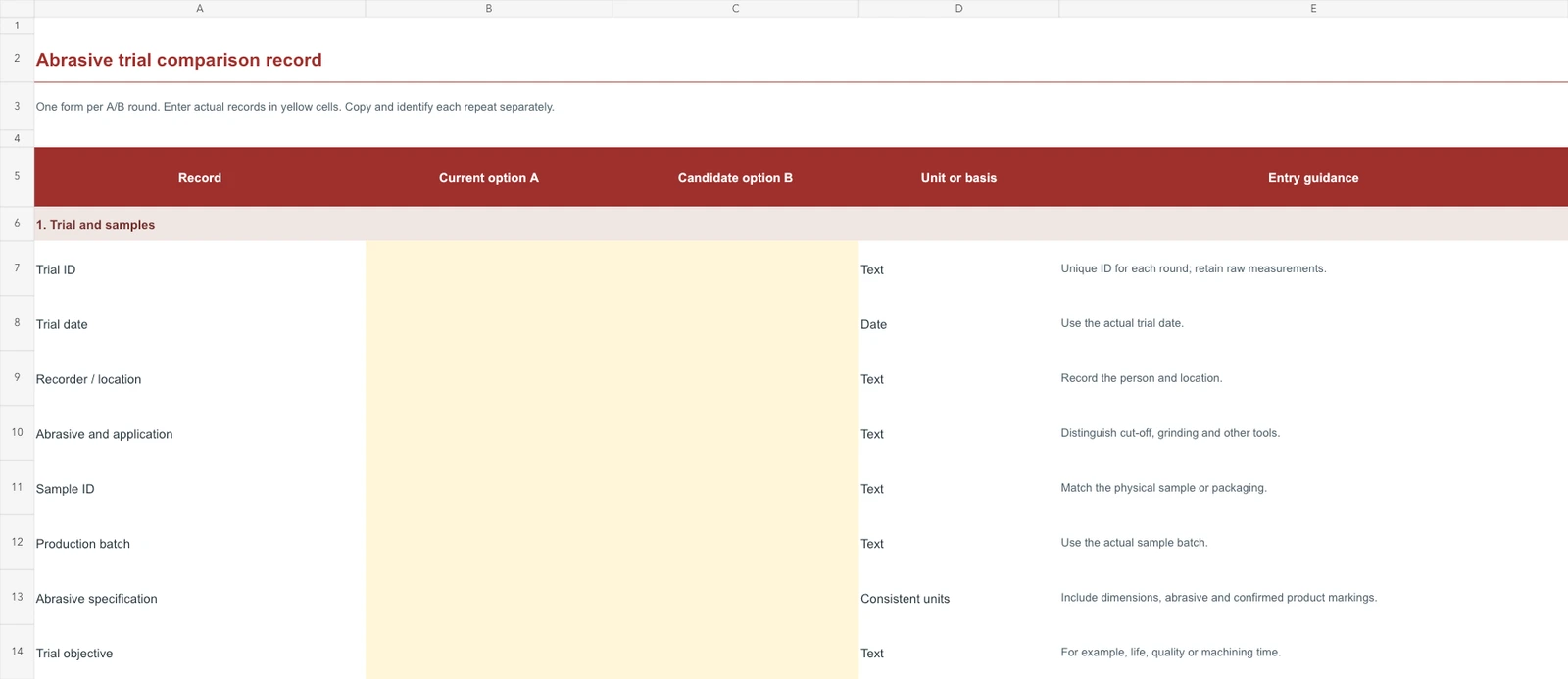
The accompanying blank Abrasive Trial Comparison Form places the current and candidate options side by side for the supplier and customer to agree before testing.
| Record | Information to define | Purpose |
|---|---|---|
| Sample identity | Abrasive specification, sample ID and production batch | Link results to a specific product |
| Workpiece | Material, condition, dimensions and batch | Identify workpiece differences |
| Equipment and conditions | Equipment model, actual parameters, fixturing and cooling | Explain how results were obtained |
| Acceptance method | Quality requirements, inspection and replacement or termination criteria | Align acceptance and continued-use decisions |
| Measured results | Completed and accepted parts, rework, abrasive use and time | Assess quality, consumption and efficiency together |
| Cost basis | Measurement method and evidence, cost basis, price evidence and rework scope | Avoid comparing different cost scopes |
| Limits of conclusions | Changed conditions, abnormalities, applicability and repeat tests | Avoid generalizing from one trial |
Use one form for each comparison round. Give repeated trials separate identifiers and retain each original record, including abnormalities, early termination and the reasons. Results may be summarized while retaining the underlying records, but the best run alone should not be selected as the conclusion. Agree the required number of repetitions beforehand, considering the trial objective and variation. The form contains no sample performance claims or preset improvement percentages.
Define the denominator and scope before comparing cost
For trials measured by workpiece count, the form provides this calculated indicator:
Abrasive cost per accepted part = abrasive quantity charged to the trial × abrasive unit price ÷ final accepted part count for that trial.
The final accepted count includes parts accepted after the trial and its associated rework. The charged abrasive quantity must cover the same trial and associated rework. Count completed workpieces once rather than counting processing passes. Parts requiring rework are a subset of completed parts and must not be added to that count again.
Use the same currency, pricing unit, consumption measurement method and quality requirements for both groups. The form distinguishes whole discs issued from measured consumption and requires a measurement basis. If charging measured consumption, explain how it was measured and converted into the pricing unit.
The cost basis distinguishes actual trial expenditure from a purchase-quotation estimate. Free samples may be recorded as zero expenditure for that trial, but this does not establish zero purchasing cost in production. For procurement assessment, enter a supported purchase quotation and retain its pricing unit and quotation record.
Basic checks on counts, quantities, prices and required explanations help identify missing information and inconsistent scope. Cost per accepted part is not applicable when no parts pass. Spreadsheet messages only assist review: the parties must still confirm measurement reliability and comparability.
This indicator covers abrasive cost only. Labor, energy, tool-change downtime and rework costs require separate records, so it cannot alone support a claim of lower total machining cost. If a project is assessed by processed area, cutting length or another unit, agree that measurement method first rather than directly applying a per-part formula.
What do testing equipment and customer trials each establish?
Existing LUMEI equipment materials describe the grinding wheel testing machine as equipment for testing the cutting performance and durability of cut-off and grinding wheels. Manufacturers preparing trial records should check whether the testing equipment, fixtures and measurement items suit the product dimensions, workpiece material and evaluation objective. Confirm the actual configuration and available tests against the equipment documentation.
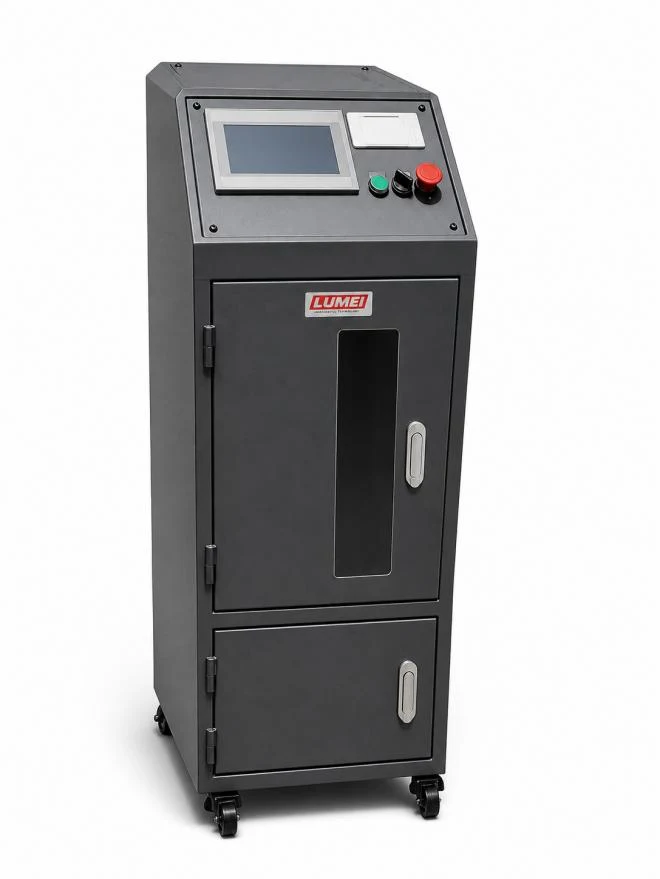
Equipment tests produce traceable records under defined conditions. Trials under the customer's actual conditions must also check compatibility with their equipment, operation and quality requirements. Laboratory results do not directly represent performance in a robotic production cell, and one comparison cannot represent all materials and conditions.
The PFERD TOOLS discussion concerns downstream applications such as grinding. Abrasive manufacturers can use its process-coordination approach to improve customer trial documentation. Changes to wheel forming, curing or manufacturing lines still require separate assessment against their own products, processes and validation results.
Prepare these records before the next trial
Prepare specifications, identifiers and batches for both abrasives, customer workpiece and equipment information, and written acceptance and termination criteria. Agree whether the comparison concerns the abrasive itself or the complete process solution, then record each round in the form below. If conditions differ substantially, explain the results and limitations separately and clarify conditions or repeat the trial before making a purchasing decision.
Prepared from public PFERD TOOLS releases. The trial-method analysis and accompanying form were developed separately for this article. No unpublished company test data are used, and the article does not establish that product performance has been validated.
Download the abrasive trial comparison workbook (Excel; select your language tab)
Tell us about your manufacturing requirements
Discuss equipment, materials, process and delivery scope.
Submit project requirements →