
180–230 Cutting and Grinding Disc Manufacturing
Use the 30 + 46 station proposal to explain machine roles and product construction
Equipment configuration and manufacturing support
Discuss the configuration against your product and site requirements.
Discuss this requirement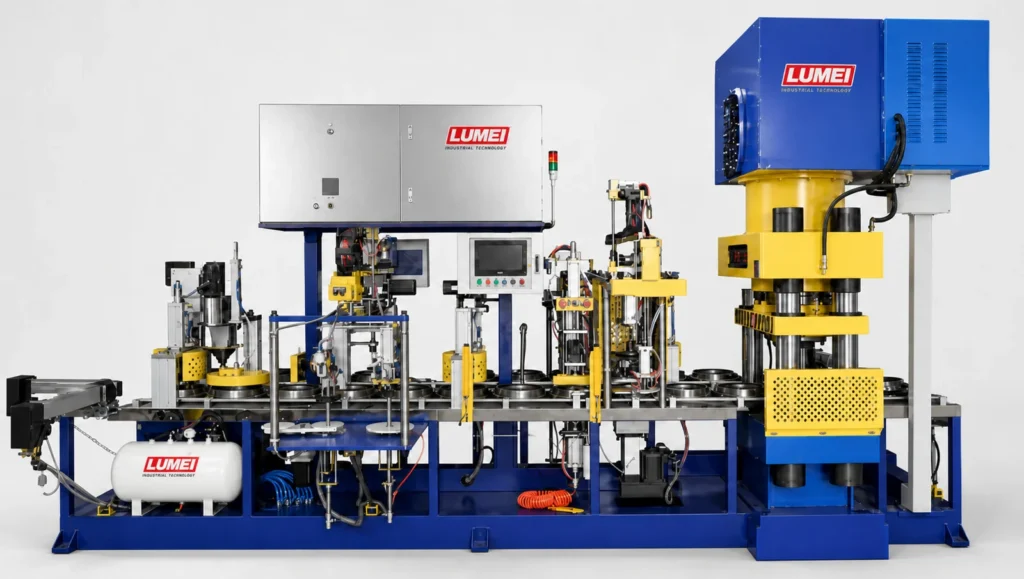
Application scenario
Scenario setting: Morocco; Mavorel Abrasives. The company name, location, and business background are fictional. This is an illustrative application scenario, not a verified customer project.
Overview
In this scenario, a Moroccan abrasives manufacturer plans to produce 180–230 mm cutting and grinding discs. Two different forming machines handle the respective product requirements, while the production plan addresses multiple sizes, material changes, and shared curing capacity.
Business Background and Production Requirements
Mavorel Abrasives, the fictional company in this scenario, supplies abrasives to industrial distributors and wants to develop both cutting and grinding product ranges. The planned mix focuses on 180 mm and 230 mm products. Cutting discs support regular replenishment orders, while grinding discs are scheduled in batches to match customers' product mixes.
The central question is how to run the two forming processes separately while sharing mixing, curing, and packaging where suitable. Adding a product range should be accompanied by a clear plan for downstream workloads.
Configuration discussions begin with product structures and the expected order mix. Cutting and grinding discs require separate mold, mesh, and feeding information. The company's proposed French or Arabic packaging artwork can be reviewed, with documentation and training languages agreed separately. These are scenario-specific arrangements, not assumptions about all Moroccan factories. Combined trials should record waiting time for each product range to support decisions on shared equipment.
Equipment Configuration
The available proposal combines a 30-station, 300 t single-head cutting disc forming machine with a 46-station, 200 t single-head forming machine with flipping stations.
The first machine uses two mesh placement stations and stepper-driven transfer for cutting disc forming. The second includes flipping, pre-pressing, and two infrared mesh detection systems for the relevant cutting and grinding disc processes.
Supporting equipment includes a 100 L mixing system, secondary mixing and vibrating screening equipment, a single-head disc stacking machine, a 5 m³ hot-air circulation curing oven, and shrink-wrapping equipment.
Scheduling Shared Equipment
Whether mixing, screening, and curing can be shared depends on the formulations, batch sizes, and process requirements. Use separate batch identification and movement records for different products. Complete the agreed cleaning and verification steps before changing the mixture.
Curing schedules must follow the confirmed process requirements; matching outer diameters alone do not establish that products can share an oven cycle. Keep labels, pack quantities, and carton formats clearly identified in the packaging area.
Layout Around Two Forming Machines
Mark each machine's feed direction, demolding position, mold change route, and maintenance space before locating shared auxiliary equipment. Confirm stacking fixture compatibility for both product groups.
If both forming machines operate at the same time, material and fixture movements may cross. Trials should check aisle use and waiting-batch locations so that transfer routes can be adjusted to the actual workflow.
Individual Trials Followed by Combined Production
First verify cutting disc forming on the 30-station machine and the selected product process on the 46-station machine. Confirm mesh placement, feeding, flipping, and pre-press settings as applicable.
Once each process is stable, run combined trials using the intended product mix. Record time spent waiting for material, fixtures, and downstream processing. Where shared equipment creates queues, review batch scheduling before deciding whether additional capacity is required.
Evaluating the Combined Configuration
The assessment should establish whether both product groups can be produced repeatedly and whether shared processes can follow the planned schedule. Record formed, awaiting-inspection, and accepted quantities separately for cutting and grinding discs.
Also review changeover preparation, batch identification, and fixture return. A single total disc count can conceal changes in the product mix and provides an incomplete basis for planning.
Where This Configuration Fits
With clearly defined machine roles, a manufacturer can schedule forming tasks by product while coordinating preparation and downstream operations. This configuration supports a mixed product range; it does not establish that the proposed curing and packaging equipment can automatically accommodate both machines at full output.
Reference Output and Configuration Limits
The 30-station machine has a reference output of 500–600 discs per hour. The 46-station machine has a reference output of 350–500 discs per hour. These are selection figures for different machines and must not be added together as a guaranteed complete-line output.
Request a Combined Cutting and Grinding Disc Line
Provide dimensions, thicknesses, mesh layer counts, product drawings, and the expected order mix for both product groups. Let us know whether simultaneous operation is required. LUMEI can define the forming machine roles and assess shared mixing, curing, stacking, and packaging equipment.
Tell us about your manufacturing requirements
Discuss equipment, materials, process and delivery scope.
Submit project requirements →