
355–405 Large Cutting Disc Manufacturing
Discuss large-disc manufacturing and inspection scope from the 500 t 20-station proposal
Equipment configuration and manufacturing support
Discuss the configuration against your product and site requirements.
Discuss this requirement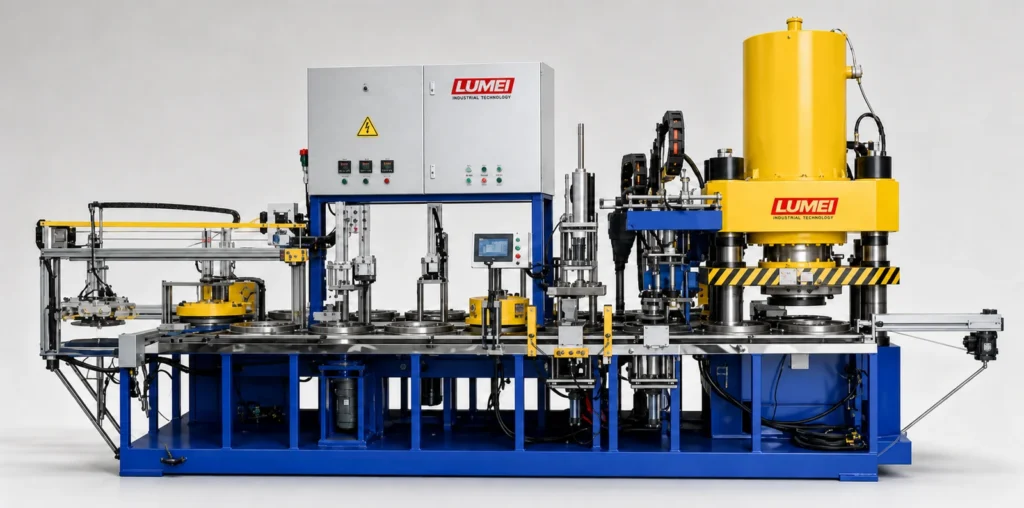
Application scenario
Scenario setting: Tanzania; Talunex Abrasives. The company name, location, and business background are fictional. This is an illustrative application scenario, not a verified customer project.
Overview
In this scenario, a Tanzanian cutting disc manufacturer plans to add large-diameter products for metalworking users and industrial distribution channels. The configuration centers on a 500 t forming machine and coordinates feeding, handling, curing fixtures, and static balance testing.
Business Background and Production Requirements
Talunex Abrasives, the fictional manufacturer in this scenario, already offers small cutting discs and plans to add 355 mm and 405 mm products. The larger range requires a separate review of tooling rather than direct reuse of every fixture from the smaller line.
The technical team wants to define product receiving arrangements, oven loading fixtures, inspection records, and packaging while selecting the main machine. This allows tooling requirements to be discussed before equipment reaches the site.
The plan starts with one main specification, followed by checks of the molds and downstream fixtures for the other size. Spare parts discussions can cover wear items and replacement procedures for the confirmed equipment, with quantities agreed against the actual configuration. Equipment identifiers, videos of the affected station, and batch records support remote troubleshooting. Power, compressed air, and loading conditions must be confirmed from factory information.
Equipment Configuration
LUMEI's available proposal uses a 20-station, 500 t single-head forming machine for 355–405 mm cutting discs with single- or double-mesh reinforcement.
The configuration includes two weighing feeders, two elevators, two volumetric feeding stages, mesh placement, material leveling, material checking, servo-driven transfer, and servo-driven demolding.
Supporting equipment includes a 200 L hydraulic tilting mixer, secondary mixing and screening equipment, a 5 m³ hot-air circulation curing oven, a BK350 manual static balancing instrument, and shrink-wrapping equipment.
Linking Feeding and Forming Records
During commissioning, check material flow and the operating sequence between the weighing feeders, elevators, and forming machine feeding stations. Trial records should link each batch to its mixture source, feeding settings, sampling checks, and machine irregularities.
If forming results vary, review feeding, mesh placement, leveling, and pressing for the same batch. Verify adjustments individually under controlled conditions so that the cause of a change remains traceable.
Preparing Handling and Curing Fixtures
Confirm how products are received after servo transfer and demolding against the actual product and factory layout. Stacking rods, retaining plates, and separator meshes must match the product dimensions. Oven loading plans also need to account for the fixture assembly and the space required to move it into and out of the oven.
During trials, separate empty fixtures, fixtures holding newly formed discs, and cured batches awaiting removal. Clear batch labels connect loading records with subsequent inspection.
Integrating Static Balance Testing
The BK350 measures static unbalance magnitude and phase. The production plan should identify which products are tested, how results are linked to batches, the operating procedure, and where records are kept. Acceptance criteria must come from the product's technical requirements and other applicable requirements.
Static balance testing is one inspection step. The complete inspection plan needs separate confirmation. A balancing instrument does not replace other required performance or safety tests and does not establish product certification.
Trial Production and Handover
Use one specification to verify feeding, forming, handling, curing, and inspection before assessing other sizes. Retain production records and samples when a batch shows irregularities, allowing forming, handling, and subsequent processing factors to be reviewed separately.
Handover information should include product-to-mold assignments, feeding settings, fixture loading instructions, and inspection record formats. These provide a basis for repeat production under comparable conditions.
Where This Configuration Fits
This approach connects large-disc forming equipment with inspection, curing, and packaging interfaces. It helps a factory organize procurement and site preparation around the intended product sizes. Static balance results should remain distinct from the findings of the complete product inspection program.
Reference Output and Configuration Limits
The 20-station, 500 t forming machine covers 355–405 mm cutting discs, with a reference output of 300–350 discs per hour. Actual output requires trials using the intended product, formulation, tooling, and supporting processes. Compatibility with 350 mm discs requires separate confirmation.
Request a Large Cutting Disc Line Configuration
Send product dimensions and drawings, single- or double-mesh requirements, output targets, and inspection needs. Include factory access routes and utility conditions. LUMEI can use these details to define the main machine, tooling, mixing, curing, and inspection scope. Please flag any 350 mm requirement for a separate compatibility review.
Tell us about your manufacturing requirements
Discuss equipment, materials, process and delivery scope.
Submit project requirements →