 EN












Start by defining the project stage
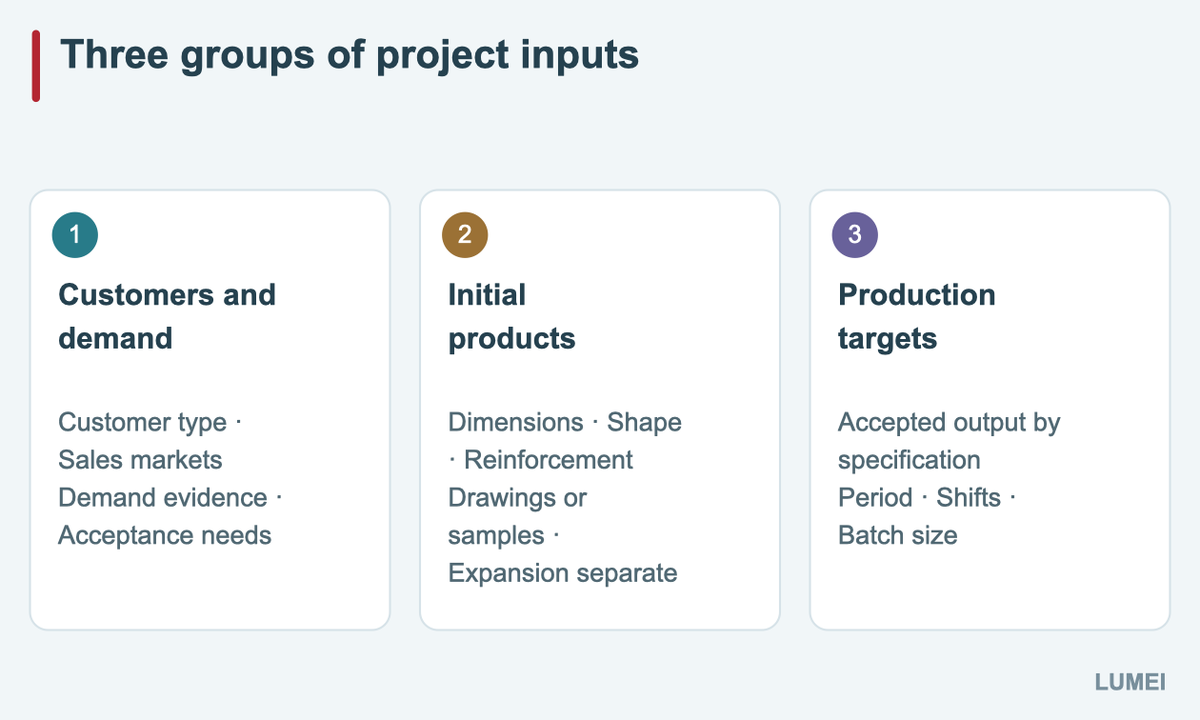
Before investing in a resin-bonded grinding wheel or cutting disc line, write down three things: what you will manufacture, whom you intend to sell to, and how many accepted finished products you need to deliver over a defined period. These inputs give suppliers a basis for discussing equipment, budgets and premises that suit your project.
You do not need every answer before making contact. Record the evidence behind confirmed information and mark unresolved items as pending. Your first enquiry can then build a useful project brief, rather than produce equipment totals that cannot be compared directly.
This article addresses preparation for a new resin-bonded grinding wheel and cutting disc factory. Equipment suitability, process conditions and costs require specific product and site information. It is not a fixed factory package or a promise of investment returns.
Define the product
Determine the first phase specifications and subsequent expansion direction.
Coordinate the equipment configuration
Let the main machine, supporting equipment and site conditions match each other.
Prepare for production
Implement installation, trial production, training and evaluation arrangements.
Use a local worksheet to fill in the known conditions, and then print or save it as PDF. No need to submit confidential formulations.
Who will buy your products?
Target customers affect the product and delivery requirements you need to establish. Distributors, brand buyers and end users may ask for different specifications, packaging, batch sizes and evaluation arrangements. Choose your initial customer group and collect its actual requirements.
Use enquiries, sample requests, correspondence or orders to identify cutting or grinding applications, workpiece materials, specifications and order combinations. Record the intended sales countries or regions and the customer’s inspection, marking and packaging requirements. Keep destination-market requirements separate from customer agreements and confirm the details. Without identified customers, label your customer and application assumptions as unverified.
Separate confirmed orders, active expressions of interest and your own market estimates. State which evidence supports quotations and capacity discussions. The quantity in one enquiry is not proof of stable long-term sales.
You do not need to forecast the entire market first. Identify one initial customer group and the product conditions it is willing to confirm. This narrows the equipment discussion.
01 Product and production plan: Define the requirements clearly
“Cutting discs and grinding wheels” is not enough to specify equipment. List representative products with outside diameter, thickness, bore, shape, reinforcement construction and intended use. Link drawings or samples to each product where available.
Outside diameter alone does not establish that one mould or machine sequence suits every product of that size. Flat cutting discs, depressed-centre grinding wheels and products differing in thickness, bore or reinforcement need checks of tooling, loading, pressing and demoulding. Match materials and process requirements to each product too.
Separate the products planned for initial production from future additions. Use the first group to assess current equipment and process support; use the second to discuss provisions and possible additional tooling, mechanisms or equipment. “It can be added later” is not evidence that all future products have been validated.
A representative product list is enough to begin discussions; confidential formulations are unnecessary at this stage. For forming equipment, see the grinding wheel making machine selection guide.
| Information | Suggested records | For confirmation |
|---|---|---|
| Product range | Outside diameter, thickness, bore diameter, reinforcement and intended use | Machine model and mold adaptation |
| Product portfolio | Main specifications, expected proportion, batch size and changeover frequency | Material supply and changeover arrangements |
| Production target | The quantity of conforming finished products and planned time period for each major specification | Production line capacity comparison |
| Shifts and Personnel | Shifts, working hours and available operation and maintenance personnel | Automation and work organization |
| Project Type | New construction, replacement or expansion; existing equipment information | Equipment reuse scope and process interfaces |
02 Equipment configuration: first ensure that the process is complete
The new factory needs to consider material preparation and mixing, molding, curing, inspection, packaging and handling as a complete process. It can be discussed to invest in the main machine in stages, but the necessary processes and inspection capabilities still need to be implemented.

When comparing candidate equipment, in addition to product range, check tooling, changeovers, effective loading capacity, material infeed and outfeed, utility and maintenance conditions. You can continue to view the complete equipment selection guide Production line equipment configuration guide ↗.
Mark each quotation item as included, optional, buyer-supplied or pending. Do not overlook moulds, curing fixtures, handling aids, inspection facilities and site interfaces. Use the production line equipment and factory preparation guide to work through the processes.
03 Factory building and material flow: The area is not just the area occupied by the machine
Provide a floor plan of the factory with dimensions and describe columns, door openings, clear heights, unloading and handling paths. The equipment layout also needs to reserve space for operation, maintenance, cleaning, mold replacement and necessary temporary storage.
- Raw material storageBatch and storage requirements
- Weighing / MixingMaterial preparation and transfer
- FormingMold and operating space
- Loading / CuringCooling and handling
- Inspection/PackagingStatus and records
- Finished product storageOrders and Shipping
- Identify existing fixed facilities and immovable or restricted areas.
- Explain the entry and exit directions, transportation methods and storage requirements of raw materials and finished products.
- Separate the expansion reservation from the actual layout of the first phase to avoid the channel being occupied by subsequent equipment.
04 Utilities: Check item by item according to equipment and site
The fact that the factory building has power supply does not mean that it has the installation conditions for all equipment. The conditions available on site should be compared on a case-by-case basis with the needs of each piece of equipment, and responsibilities for preparing and connecting each interface should be clear.
| Conditions | Information to be provided | Contents to be confirmed in the plan |
|---|---|---|
| Power supply | Voltage, number of phases, frequency, available capacity and distribution conditions | Equipment Requirements, Power Distribution and Wiring Responsibilities |
| Compressed air | Existing compressed-air supply and available conditions; state if none is available | Air supply and treatment requirements for pneumatic equipment |
| Ventilation and dust removal | Materials, Processes, Site Facilities and Limitations | Arrangements adapted to materials and processes |
| Entry and Basics | Door openings, unloading, ground and handling conditions | Foundation, Installation, Connection and Acceptance Responsibilities |
| Storage and environment | Storage conditions of raw materials, mixtures and finished products | Applicable storage requirements and status identification |
Specific capacities and site requirements should be confirmed by the equipment supplier with appropriate local installation professionals. When there is no project data, it is not appropriate to apply uniform power, gas volume or area.
05 Capacity coordination: unify products, time and units
Taking the final qualified finished product as the goal, compare the available capacity of each process under the same product combination and planning period. When the mixture is measured by mass, it needs to be converted based on the product input weight; curing is evaluated based on effective loading and complete occupancy cycles; inspection is based on piece-by-piece or sampling task arrangements.
Mixing → Molding
Can the single batch weight, discharging and temporary storage conditions support planned feeding?
Forming → Curing
Does the arrival speed of the formed pieces match the oven loading capacity, cycle and handling tooling?
Inspection → Packaging
Can the detection tasks, judgment and packaging operations be completed as planned?
Product changeovers, loading and unloading, cleaning, planned shutdown and quality loss should be considered according to the actual conditions of each process. kg/h, pcs/h cannot be directly compared with the furnace volume, nor should the same loss be deducted repeatedly.
“Pieces per day” must specify the products, shift pattern, measurement period and whether the count covers pressed blanks or finished products that have passed the required checks and been released.
For each main specification, record the target accepted quantity, demand period, batch size and expected changeovers. Equipment and process personnel can then assess whether mixing, forming, curing, inspection and packaging can follow the same schedule. Keep demand targets separate from validated equipment capability: a target does not prove capacity.
A press’s reference blank-output rate is not the line’s deliverable output. Effective curing load and full occupancy cycle, material movement, inspection, packaging, changeovers and downtime all affect scheduling. Counts for different specifications can be totalled for a stated product mix. Capacity comparisons must also align the mix, measurement period and finished-product definition; a total count alone is insufficient.
Consider two hypothetical projects, both requesting a “fully automatic line”. One plans long runs of a few specifications; the other expects varied small orders. The first needs attention to continuous supply, process coordination and sustained operation. The second also needs detailed checks of changeovers, cleaning, tooling and batch transitions. “Fully automatic” alone cannot establish identical configurations, lower labour needs or better economics.

06 Installation, training and trial production: clarify responsibilities in advance
List material and process management, operation and maintenance, quality inspection, batch records and abnormal-condition handling. Identify responsible staff and required training or support. Agree training content, documents, service scope and how task capability will be confirmed afterwards. Operator training alone does not establish full process-development or quality-evaluation capability.
Trial preparation includes material batches, suitable tooling, product and process revisions, sample identification and evaluation items. Arrange machine testing, product trials, performance evaluation and final release separately. Use trial production and validation support to define sample and evaluation arrangements, with unresolved items, owners and follow-up plans recorded.
| Stage | Buyer is ready to confirm with both parties | The result that should be formed |
|---|---|---|
| Configuration confirmation | Products, equipment, molds, supporting and supply boundaries | Scope list and matters to be confirmed |
| Installation readiness | Unloading in place, power supply, air source, personnel and site conditions | Site Readiness Checklist and Connection Responsibilities |
| Trial production preparation | Material batches, samples, process versions and evaluation projects | Trial production plan and record format |
| Trial production and evaluation | Process conditions, basis for measuring output, applicable inspections and result disposition | Traceable trial production and evaluation records |
| Training and handover | Operations and maintenance personnel, courses, materials and service contacts | Training, information and follow-up support arrangements |
If the project adopts factory or on-site acceptance, the objects, methods and passing conditions should be agreed in the contract. Trial production results, equipment acceptance and final product release are confirmed separately and cannot be replaced by each other.
Related instructions:Trial production and test verification ↗、Installation training and after-sales ↗.
07 First round of communication, just prepare this information
The first discussion does not require complete information, but everyone should understand the current preparation stage. Use the table to identify the next action instead of substituting an unchecked total price for a project proposal.
| Current position | Information to add first | Next discussion |
|---|---|---|
| Investment interest only; products and customers unclear | Customer group, sales destinations, application, representative specifications and demand evidence | Narrow initial products and identify assumptions to validate |
| Products provisionally defined; volumes and order mix unresolved | Targets by specification, demand period, batches and shifts | Set conditional targets and check process loads |
| Products and targets clearer; equipment and site unresolved | Equipment scope, existing resources, site plan and utilities | Discuss configuration, interfaces, responsibilities and a budget with stated scope and conditions |
| Configuration and site ready for trial preparation | Materials, tooling, personnel, methods and evaluation arrangements | Run agreed trials, retain records and assign outstanding issues and follow-up completion actions |
These positions organise discussions; they are not fixed approval stages or proof that all production-start conditions have been met. Equipment, process, site and quality matters still require separate confirmation for the project.
You can use the following format for a first-contact brief. It is a fill-in example, not a real customer case. Replace bracketed fields with your information and write “pending” where unresolved.
We plan a resin-bonded grinding wheel line in [project location], serving [customer type] in [sales countries or regions]. Initial products are [application, outside diameter × thickness × bore, shape and reinforcement; drawings or samples attached separately]. Demand is based on [orders, expressions of interest or market assumptions]. Customer inspection, marking and packaging requirements are [details]; confirmation of destination requirements stands at [status].
Over [period], using [shift pattern], we plan to deliver [accepted finished quantity by specification]. Order mix and changeovers are [details]. These are planning targets; capability remains to be validated. Existing premises and equipment are [details]. We want the supplier to provide [specific supply, installation or training scope]. The main issue requiring help is [details]; other unresolved items are [details].
Use the existing factory project worksheet to record known information and pending items, with relevant drawings or sample information. Submit available site information with the brief and agree with LUMEI what to prepare for the next discussion.
The first useful result of planning a resin-bonded grinding wheel line is a clear set of project inputs: defined products, evidence behind demand and a stated output measurement basis. Use that brief to assess equipment, funding, premises and trials so that competing proposals address the factory you actually intend to build.
- Product size, structure, usage, and available samples or drawings.
- Main specification combinations, target qualified quantities, shifts and hours.
- Project location, phases, plant diagrams, and known utility conditions.
- Existing equipment, personnel and scope are expected to be the responsibility of the supplier.
- Planning time, trial production, training and data delivery requirements.
The filled-in version supports printing; the blank version can be directly downloaded and saved.
New factory plan ↗ · Cutting discs manufacturing scheme ↗ · Installation training and after-sales ↗
Base budgets and premises on the same project conditions
Record equipment supply prices, project implementation expenditure and routine operating costs separately. Check whether transport, site preparation, installation, initial materials and working-capital needs are included, avoiding omissions and double counting. Align currency, quotation date, delivery terms and scope when comparing amounts. Unresolved costs remain pending, not zero. Continue with the production line cost and quotation guide and its checklist.