 EN












Starting a Grinding Wheel Factory: Cutting Discs or Grinding Discs First? Choose Initial Products by Customer Needs, Specifications and Equipment Fit
Published
Choose initial cutting or grinding discs by demand, specifications, added investment, equipment fit and sample evaluation. Includes comparison tables and a hypothetical decision example.
Equipment configuration and manufacturing support
Discuss the configuration against your product and site requirements.
Discuss this requirement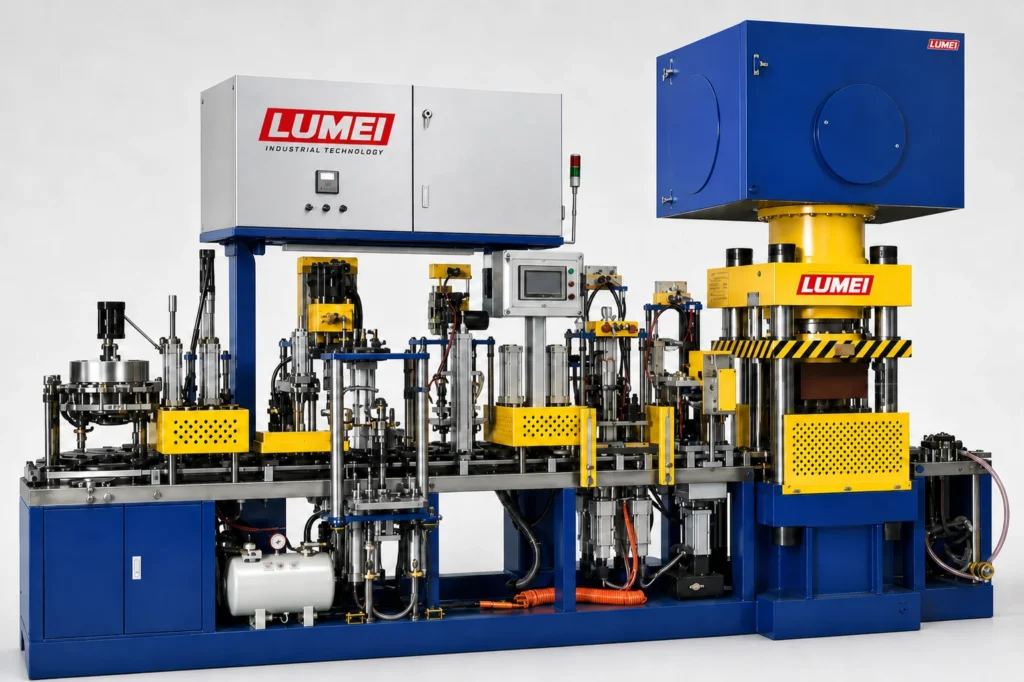
When investing in a resin-bonded abrasive production line, deciding whether to start with cutting discs or grinding discs often deserves attention before choosing a machine. Both may be sold through the same distributor, yet serve different tasks and require different structures and evaluation methods. A customer saying they can sell both is not enough to put both into initial production.
Prioritize a product group with clearer customer demand, a manageable specification range, and achievable manufacturing and evaluation arrangements. Assess cutting discs first if their purchasing requirements are specific. Grinding discs can be the starting point when their customers, samples and trial conditions are better defined. Launching both requires clear product requirements, configurations and validation plans for each.
This article compares common resin-bonded cutting discs for metalworking with depressed-centre resin-bonded grinding discs for angle grinders. “Grinding discs” here does not mean every type of grinding wheel. Vitrified wheels, superabrasives and flap discs are outside this comparison.
1. Ask What the Customer Does Before Asking Which Disc They Want
“Serving the metalworking market” is still too broad. Cutting pipe and removing welds are different tasks; workpieces, tools and evaluation methods must be recorded separately.
Ask what material is processed, what operation is performed, which tool is used, what product is currently purchased, and why the customer is considering a new supplier. Where existing product markings, drawings or samples are available, use them to establish requirements that can be confirmed.
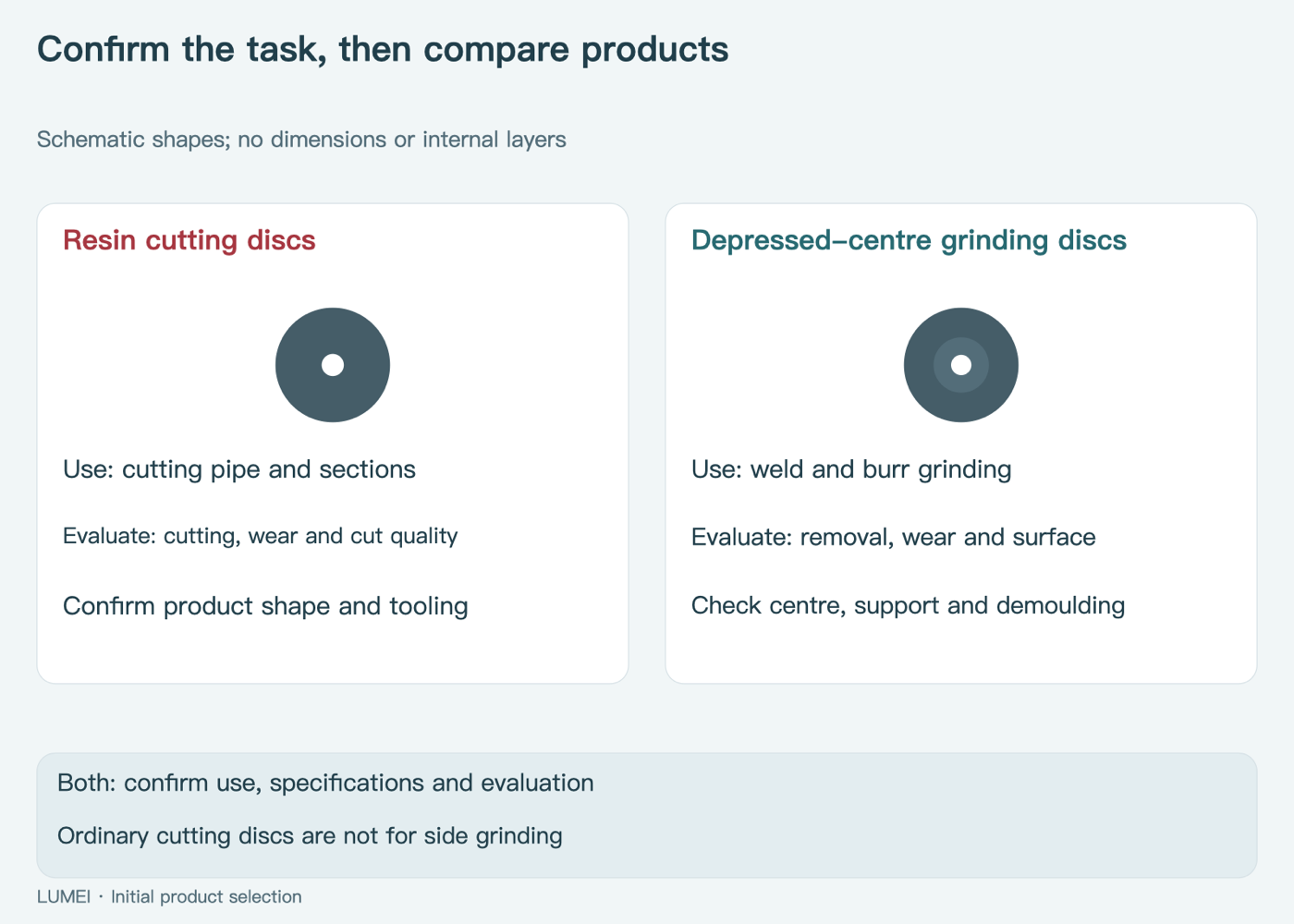
Ordinary cutting discs are for cutting; grinding discs are for the grinding tasks permitted by their design. Do not evaluate or sell an ordinary cutting disc as a disc for side grinding. Special combination products must follow their stated design, markings and conditions of use. Norton’s cutting and grinding safety guidance also explains the limitations of side grinding with cutting discs.
| Comparison | Cutting discs | Depressed-centre resin grinding discs | Effect on the initial choice |
|---|---|---|---|
| Customer task | Cutting pipe, sections and other workpieces; confirm the actual application | Grinding welds, burrs and similar features; confirm contact conditions | Obtain a defined task rather than treating “metalworking customers” as a product requirement |
| Shape and forming | Confirm flat or other shapes for the target product; cutting discs do not all share one structure | Confirm the depressed centre, support and demoulding arrangement | Include shape differences in tooling assessment, not only outside diameter |
| Product evaluation | Cutting performance, disc consumption and cut quality under agreed conditions | Material removal, disc consumption and surface requirements under agreed conditions | Establish separate sampling and evaluation plans; disc life alone is insufficient |
| Purchasing basis | Cutting task, specification mix, batch size and delivery cycle | Grinding task, specification mix, batch size and delivery cycle | Compare which demand has supporting information and follow-up evaluation, without assuming higher sales for either category |
Both require confirmation of diameter, thickness, bore, reinforcement, tool compatibility and speed compatibility. The table distinguishes product directions; it is not a complete inspection specification. Applicable destination-market requirements, product safety evaluation and release conditions must be confirmed separately.
Distinguish enquiries, sample-trial intentions and confirmed orders. A size appearing in a distributor’s catalogue does not mean they are ready to buy it. A claim that the market is large cannot determine machine quantities.
2. Define Initial Products as a Specification Mix
Choosing “cutting discs” or “grinding discs” establishes only a broad direction. Purchasing and trials depend on which specifications will be made, how they differ and how production will change between them.
Group customer requirements into an initial product range. Record shape, finished dimensions, application material, reinforcement requirements and evaluation conditions. Mark unknown items as pending confirmation instead of copying assumptions from similar products.
Keep these distinctions clear:
- The same diameter with a different thickness or bore may still require different tooling and adjustments.
- Identical dimensions with different workpiece materials or tasks do not automatically define the same product.
- A finished sample does not directly replace green-body or mould drawings.
- Reinforcement specifications, positions and layer arrangements must follow the target design; appearance alone cannot establish them.
The initial range may include several specifications, but each addition should have an identified effect on tooling, materials, changeovers and evaluation. List possible future products separately so that unconfirmed demand does not fill the first purchasing list.
3. Compare the Order Mix and Additional Investment, Not Only Machine Output
Two projects with the same planned monthly disc count may need very different production arrangements. Repeating stable batches is not equivalent to frequently switching among small batches, and a machine cycle time cannot capture that difference.
List demand periods, expected batch sizes and delivery schedules by specification. Then examine mould changes, cleaning and material changes, setting adjustments, restart and first-piece inspection. Actual materials and processes determine which tasks are necessary; changeover duration should be based on records for the agreed product mix.
This directly affects initial investment. More products may also mean more tooling, raw materials, work in progress and batches awaiting inspection. Buying moulds for additional sizes does not establish matching production, inspection and delivery capability.
Alongside expected sales, assess demand credibility, the number of specifications, repeat-purchase prospects and the customer’s willingness to participate in sample evaluation.
Before adding another category, list its additional requirements. Similar prices for the main machine do not mean that two starting plans require the same startup funds.
| Additional item | Questions for the proposal or quotation | Omission to avoid |
|---|---|---|
| Moulds and tooling | Which moulds, locating parts, supports and replacement parts correspond to each product? | “Changeable moulds” does not mean all tooling is included |
| Mechanisms and supporting equipment | Are additional mesh placement, feeding, receiving, loading or inspection arrangements needed? | “Shared” in two separate plans does not establish simultaneous availability |
| Trials and evaluation | Who pays for samples, materials, trials, external testing and customer trials? | Separate initial trials from repeat trials; do not assume all evaluation is included in the equipment price |
| Materials and inventory | What materials, reinforcement parts, packaging and minimum order quantities are added, and for how long are funds tied up? | Distinguish initial stock from later consumption; do not count the same purchase twice |
| Changeovers and personnel | What adjustment, cleaning, training and inspection work is needed, and how will times be established? | Keep unmeasured times pending; do not assume extra specifications cause no production loss |
Mark each item as included, additional or pending confirmation. State currency, source date and payment timing for costs. Without reliable sales and cost information, do not conclude that cutting discs pay back faster or grinding discs are more profitable.
4. Confirm Equipment Sharing Product by Product
Both categories involve material preparation, mixing, forming, curing and subsequent inspection. Shared process names do not establish interchangeable configurations or processes. A stated diameter range also cannot establish suitability for every shape, thickness and reinforcement structure.
When considering the other category, ask the supplier to explain three points for that product group:
- What the existing configuration covers. Identify drawings, tooling, movements and remaining manual tasks. “Suitable for cutting and grinding discs” is insufficient.
- What must be added or changed. Identify tooling, mechanisms, material changes, curing loads and inspection conditions, together with costs and responsibilities.
- What has been validated and what remains unvalidated. Record documented configuration compatibility separately from completion of agreed product evaluation.
If mixing, curing or inspection resources are shared, place both product groups in one production schedule. Handling each separately does not establish the ability to deliver both independent targets simultaneously. Define both the shared scope and available time.
For detailed checks, see the grinding wheel forming machine selection guide. First define what must be produced, then use that guide to assess how it can be achieved.
5. Validate the Choice with Representative Samples
Choose products representing the main order mix and its critical differences. Different tasks mean that trials of one category cannot establish that the other also meets requirements.
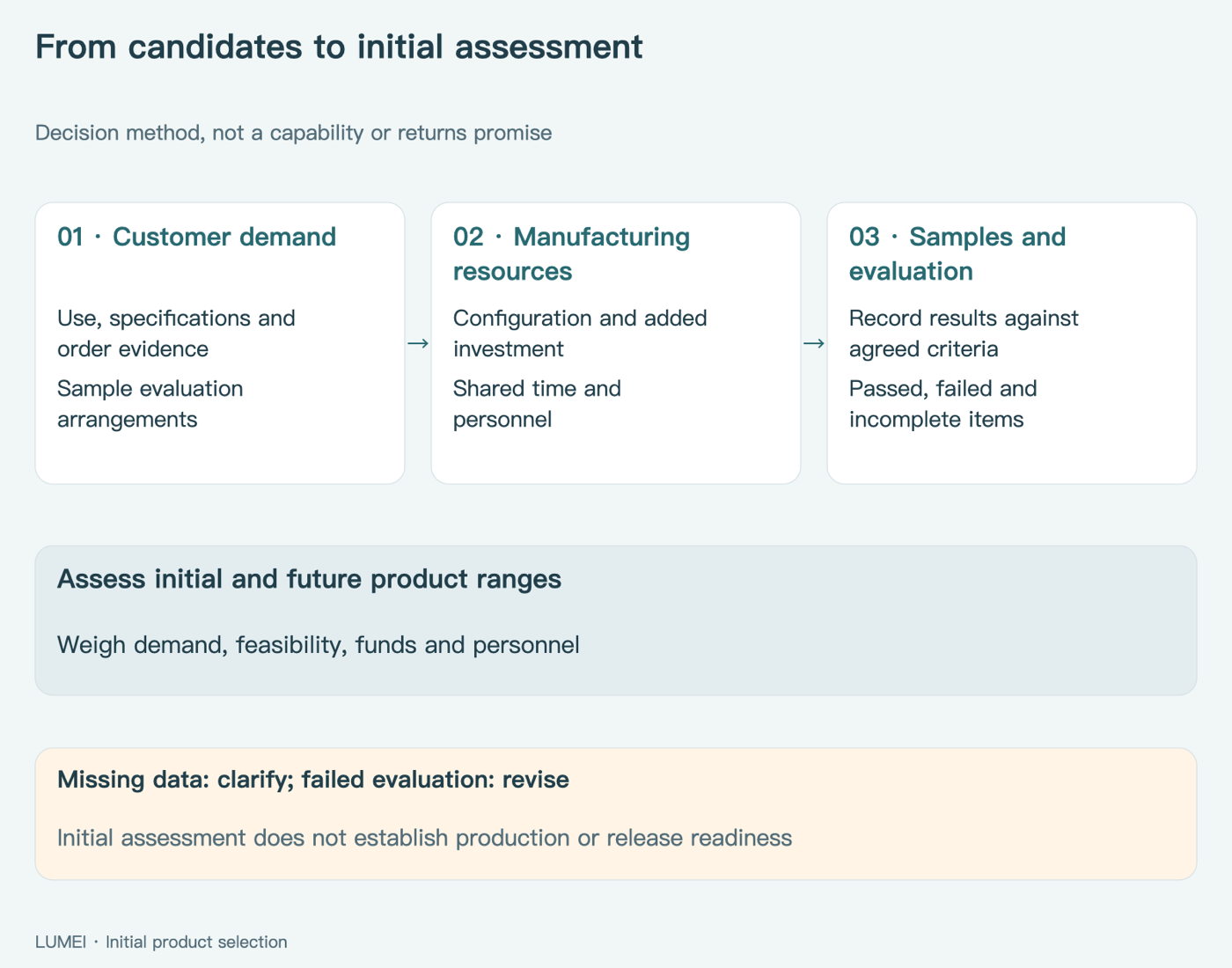
Before trials, agree product versions, materials, tooling, sample quantities, evaluation conditions and acceptance criteria. Link sample identifiers to production records. Distinguish three outcomes: whether the agreed configuration can manufacture the product; whether cured products have completed the relevant quality, performance and applicable safety evaluations and met their criteria, including failed or unfinished items; and whether customers accept the evaluated items under defined use conditions.
A formed green body does not establish finished-product conformity. Customer acceptance of one attribute cannot replace unfinished evaluation. See trial production and validation services for input and recording arrangements.
6. Decide Priorities from Readiness
Suppose an investor is considering both categories. The following is a hypothetical explanation of the method, not a LUMEI customer case or a forecast of demand or returns.
| Candidate | Information assumed available | Still missing | Action at this stage |
|---|---|---|---|
| Cutting discs A and B | The customer has specified applications and two sizes and will evaluate samples under agreed conditions | Firm purchase quantities, configuration confirmation, trial and finished-product evaluation results | Assess for the initial range; establish drawings, evaluation and configuration without promising volume production |
| Depressed-centre grinding disc C | The same customer may purchase grinding discs later | Detailed task, product information, batch sizes and trial arrangements | Keep as an expansion candidate; clarify demand before adding a complete initial configuration |
In this situation, advance the information review and trial plan for A and B first. They take priority because they have inputs for further assessment, not because cutting discs are easier to manufacture or more profitable. Revise the initial plan if evaluation fails or order and cost conditions do not support it.
If the information is reversed—defined grinding-disc tasks and trials, with only verbal interest in cutting discs—assess grinding discs first. Weigh demand credibility, technical feasibility, funds and personnel when deciding priorities.
Where both have clearer demand, compare additional investment, resource sharing and validation plans before choosing simultaneous construction or phased production. Where neither has specific requirements, complete customer interviews and sample information first. Investment boundaries can be explored without finalizing equipment configuration.
7. Write an Initial Product Plan That Can Be Checked
For the first supplier discussion, there is no need to include the entire future catalogue. Enter initial target products in this checklist and leave missing information pending.
| Decision item | Information to enter | Evidence or responsible party |
|---|---|---|
| Customer and use | Who buys, what is processed and what task is performed | Demand records, customer or project lead |
| Product range | Category, shape, dimensions, structure and version | Drawings, markings, samples and technical confirmation |
| Order basis | Enquiry, sampling intention or order; mix, quantity and period | Sales records or customer confirmation |
| Production target | Specifications, reporting period and target conforming finished quantity | Project target, recorded separately from measured capability |
| Manufacturing and configuration | Tooling, supporting equipment, shared scope, additions and limitations | Supplier documents and pending items |
| Additional investment | Tooling, mechanisms, trial evaluation, stocking and related time costs | Included scope, quotation basis, payment timing and pending items |
| Trials and evaluation | Representative products, methods, criteria, responsibilities and unfinished items | Trial plans, evaluation records and responsible parties |
| Future expansion | Products not initially launched and reassessment conditions | Separate expansion list, outside initial commitments |
The useful result is a clear statement: these initial products serve customers with defined uses; these conditions are confirmed and others require validation. Decide whether to add the other category when demand and manufacturing conditions become clearer.
For discussions with LUMEI, consult the cutting disc manufacturing solution or resin grinding disc manufacturing solution, and provide product information, samples, demand periods and existing site conditions. For the wider project, return to the grinding wheel factory preparation guide.
Tell us about your manufacturing requirements
Discuss equipment, materials, process and delivery scope.
Submit project requirements →