
107–125 Cutting Disc Manufacturing
Discuss small-disc manufacturing with the documented 68-station press and coordinated material, mixing and curing requirements
Equipment configuration and manufacturing support
Discuss the configuration against your product and site requirements.
Discuss this requirement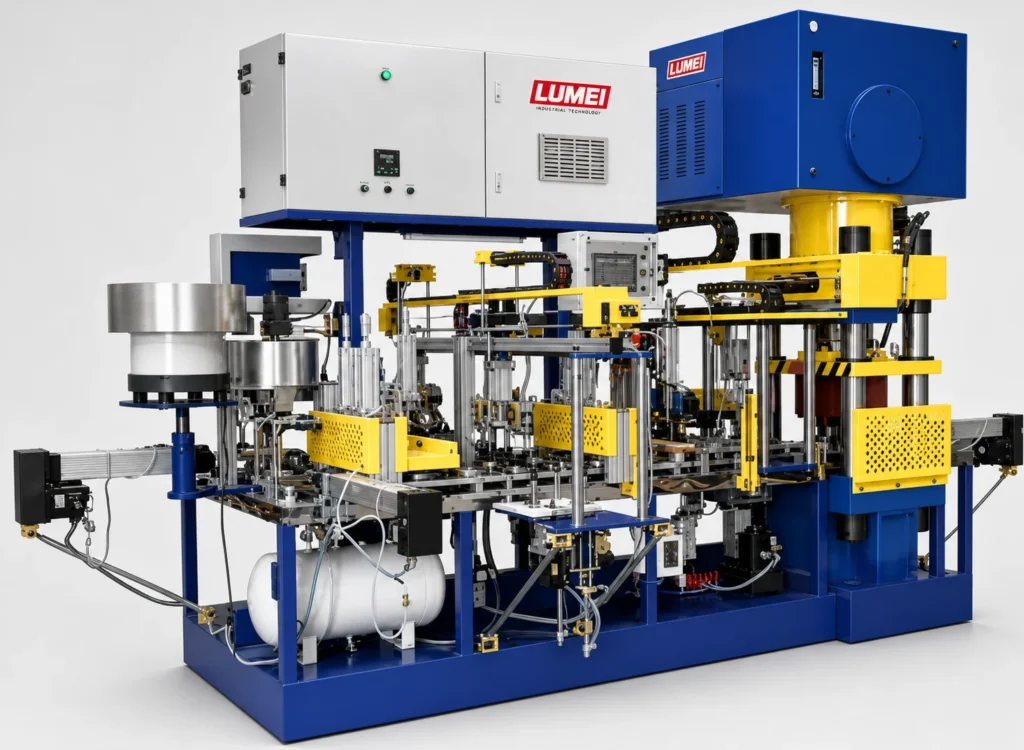
Application scenario
Scenario setting: United Arab Emirates; Lurava Abrasives. The company name, location, and business background are fictional. This is an illustrative application scenario, not a verified customer project.
Overview
In this scenario, a UAE cutting disc manufacturer plans a new 107–125 mm line for its own brand. Production is organized around core sizes, with other sizes scheduled in separate batches to serve hardware distributors and metalworking users. The configuration brings forming, stacking, curing, and packaging into one production plan.
Business Background and Production Requirements
Lurava Abrasives, the fictional manufacturer in this scenario, produces resin-bonded cutting discs for hardware distribution channels and metalworking users. Its new small-diameter line would initially focus on 115 mm and 125 mm discs, with compatibility for 107 mm products also assessed.
Orders include standard own-brand packs and smaller packaging runs for distributors. The production manager therefore needs a workable schedule for core products and a way to change labels and carton formats without disrupting upstream production.
The initial objective is to establish a complete process for one main specification, from raw material batch identification and mold and reinforcing mesh checks through forming, stacking, oven loading, and packaging. Production can be grouped by specification, then divided into the agreed packaging formats. Equipment access, site utilities, and the language used for training must be confirmed with the factory rather than assumed from its country.
Equipment Configuration
LUMEI can use a 68-station, 200 t dual-head forming machine as the core of the line. Its configuration includes volumetric feeding, two reinforcing mesh placement stations, servo-driven transfer, and demolding mechanisms.
Supporting equipment can be selected from the existing line proposal: a 200 L hydraulic tilting mixer, a secondary mixer, a vibrating screen, a dual-head automatic disc stacking machine, a 5 m³ electrically heated hot-air circulation curing oven, and shrink-wrapping equipment. Compressed air requirements are checked alongside the final equipment configuration.
Factory Layout and Material Flow
Plan the flow from raw material preparation to mixing and screening, forming, stacking before curing, post-curing inspection, and packaging. The layout should identify the supply route from the mixing area to the forming machine, transfer positions for loaded fixtures, and oven loading and unloading space.
Assign holding areas to specific functions, such as returning empty fixtures or keeping batches awaiting inspection. Production aisles should remain available for movement. Confirm power, compressed air, and ventilation requirements against the final equipment list.
Initial Production Trials
Start with one specification and check feeding, mesh placement, pressing, demolding, and stacking in sequence. Record where any irregularity occurs and how it is addressed. Use batch identifiers to link raw material lots, mixing records, forming machine settings, oven loading records, and inspection results.
If a missing-mesh indication, demolding issue, or stacking misalignment occurs, follow the machine's operating procedures to stop and inspect the relevant station. Resume only after the necessary checks. Increasing speed should not substitute for resolving an underlying issue.
Matching Curing Capacity to the Line
The oven's 5 m³ volume cannot be converted directly into a daily quantity of accepted discs. Scheduling must account for fixture loading arrangements, the actual process cycle, loading and unloading time, and fixture turnaround.
If batches accumulate before curing while the forming machine runs normally, check the oven schedule, loading organization, and number of available fixtures before changing the equipment configuration. Allow for material changes, specification changes, and planned maintenance when assessing sustained production.
Startup Targets and Production Handover
The first target is a complete production sequence for one main specification, supported by a repeatable setup sheet, tooling list, and batch records. Other sizes can then be used to verify mold changes, mesh placement, and stacking compatibility.
At handover, operators should demonstrate startup preparation, specification changes, shutdown cleaning, and issue reporting. This helps move the line from commissioning into routine production management.
Where This Configuration Fits
This approach suits a factory establishing production around a main cutting disc range before adding other forming equipment as its order mix develops. It identifies the equipment and tooling that need to be purchased and commissioned, supporting practical planning for space, personnel, and trials.
Reference Output and Configuration Limits
The 68-station forming machine covers 107–125 mm cutting discs, with a reference output of 1,200–1,300 discs per hour. This is an individual machine selection figure, not a verified customer result or the complete line's accepted finished output. Actual production depends on the formulation, thickness, molds, and supporting process cycle times.
Request a Small Cutting Disc Line Configuration
Send your target disc diameter, bore size, thickness, reinforcing mesh structure, output target per shift, and factory layout. LUMEI can use this information to coordinate forming, mixing, stacking, curing, and packaging, and define the initial molds and fixtures required.
Tell us about your manufacturing requirements
Discuss equipment, materials, process and delivery scope.
Submit project requirements →